
Food prices are also expected to move up due to the poor monsoons.

The Nikkei India Manufacturing PMI dipped from 50.3 in November to 49.1 in December.
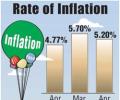
Food prices rose 8.64 per cent year-on-year last month, slower than an annual rise of 9.90 per cent in March.

India's consumer price index (CPI)-based inflation could ease in the coming months thanks to the arrival of kharif crops, lower international commodity prices, and a pass through of lower input costs to consumers, the finance ministry said in its Monthly Economic Review (MER) for October, which was released on Thursday. The MER, however, warned that the global macroeconomic situation remained precarious and a recession in many advanced economies would impact India's exports. "Easing international commodity prices and new Kharif arrival are set to dampen inflationary pressures in the coming months.

Industry bodies called for implementation of measures announced in the Budget to arrest inflation, saying these would pave the way for a stable inflation regime.

'The robust tax collections give the finance minister a fair amount of headroom for an expansionary fiscal policy.'

'If you see the composition of items which are causing this spike in prices, most of them have little to do with the kharif harvest, except for pulses and vegetables to some extent.' 'I don't know on what basis the government is claiming that food prices will moderate in the weeks to come.'

Benchmark indices Sensex and Nifty ended with gains on Wednesday, extending the previous day rally amid lower level of inflation on domestic front and better-than-expected inflation readings from the US. The 30-share BSE Sensex climbed 144.61 points or 0.23 per cent to settle at 62,677.91. During the day, it jumped 301.81 points or 0.48 per cent to 62,835.11.
Softening of global commodity prices might not help much

WPI at 3-month high; surge in all broad categories; CPI at 2-month high.
Inflation in the 'fuel and power' basket in December slumped to 8.38 per cent, nearly half of 16.28 per cent.
Though inflation, on the basis of the wholesale price index, is nowhere near the 1990-91 level of 10.26 per cent and India is in a much better position to check it, the greater integration of our economy with the globe has exposed it to a much higher risk of imported inflation.
RBI has kept interest rate unchanged at 8 per cent since January
.jpg)
Food and fuel inflation in India have remained high for several years, the paper said, adding to durably reduce the current high inflation, the monetary policy stance needs to remain tight for a considerable length of time.

Reversing a six month declining trend, WPI inflation moved up marginally to 0.11 per cent in December mainly because of increase in prices of food items.

The price rise measured in terms of Wholesale Price Index rose for the second straight month, to 5.79 per cent in July, on account of double digit rise in prices of food articles, mainly vegetables, including onion.

Last week, the Consumer Price Index-based inflation for the month had contracted to 4.4 per cent.

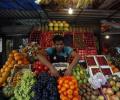
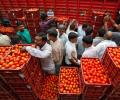
Costlier fruits and vegetables such as onions and tomatoes pushed retail inflation to a nine-month high of 11.24 per cent in November, making it harder for the Reserve Bank to lower interest rates.
The survey showed firms passed on a greater cost burden to consumers. Prices charged rose at their fastest pace since October.

Food articles inflation at 8.43% compared to 8.14% m-o-m.

The Reserve Bank had kept policy rate unchanged in its review on April 7.

A little away from the city in the northern suburbs, vegetables are 15-30 per cent costlier.
The finance ministry has proposed that services should be included in the widely tracked wholesale price-based inflation index to reflect true picture of price changes in the economy.

For August, CRISIL core inflation indicator stood at 3.6 per cent, a tad higher than RBI's measure.

Trading in the equity market this week will be highly influenced by a host of important triggers, with quarterly earnings from IT majors TCS, Wipro, and domestic inflation and IIP data taking the centre stage in dictating the movement in equities, analysts said. Besides, global factors and trading activity of foreign investors will also drive markets. "We are approaching the first quarter earnings season, with HCL Tech, TCS and Wipro set to report their earnings this week.

Monetary Policy- Easing expected to happen later this financial year.

Maruti Suzuki, Hyundai and Tata Motors reported their highest-ever dispatches to dealers last fiscal, enabling the domestic passenger vehicle industry to log in best-ever performance to date. The country's largest carmaker Maruti Suzuki India reported its highest wholesales to date at 19,66,164 units, up 19 per cent from 16,52,653 units in 2021-22. Its domestic dispatches rose to 17,06,831 units in 2022-23, up 21 per cent from 14,14,277 units in 2021-22 fiscal.Hyundai Motor India said its overall wholesales last fiscal were the highest ever since commencing operations in the country.

Pulses cropping has jumped to 39.4 per cent above 2015 levels.

Food prices, which have contributed to a large part of inflation over recent years, have remained benign, despite unseasonal rain.

RBI has cut policy rate thrice during 2015.

RBI Governor Raghuram Rajan will announce the monetary policy on April 1 and expectations of a status quo are rising ever since the official data on consumer price inflation for February pointed to a cool down to 8.1 per cent.
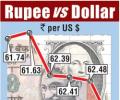
The previous bout of Fed withdrawal fears had threatened to spark a crisis of confidence in India -- sending the rupee to a record low of 68.85 in late August and leading to steep falls in bonds and stocks.

Recommends delisting of chana futures, open to lowering sugar import duty

Across the board, demand would appear to be slacker than it should be if we are headed for a healthy recovery.

Wholesale price-based inflation eased to a nine-month low of 4.68 per cent in February, while retail inflation slowed to a 25-month low of 8.1 per cent.
CPI inflation has declined by almost a percentage point from July, from close to eight per cent to just above seven per cent.

Data showed the country's wholesale price-based inflation eased to an eight-month low in January as food prices moderated, offering some relief to policymakers who have long battled to get a handle on surging prices.

Disagreeing with Reserve Bank's projection on the price situation, former RBI Governor and PM's Economic Advisory Council chairman C Rangarajan said WPI and CPI may not be as high as being projected by the central bank.

'We have lived through 10% plus inflation in India and we are aware of the economic pitfall.' 'With the RBI now having formally adopted an inflation target range, they cannot turn a blind eye to the impending risks.'

In its mid-quarter review of monetary policy, RBI on Wednesday kept all key interest rates unchanged notwithstanding persistent high inflationary pressure.
 © 2026 Rediff.com - Advertise with us - Disclaimer - Privacy Policy - Sitemap - Feedback - About us - Terms of use - Grievances